03 9818 8593
 Hawthorn





Description
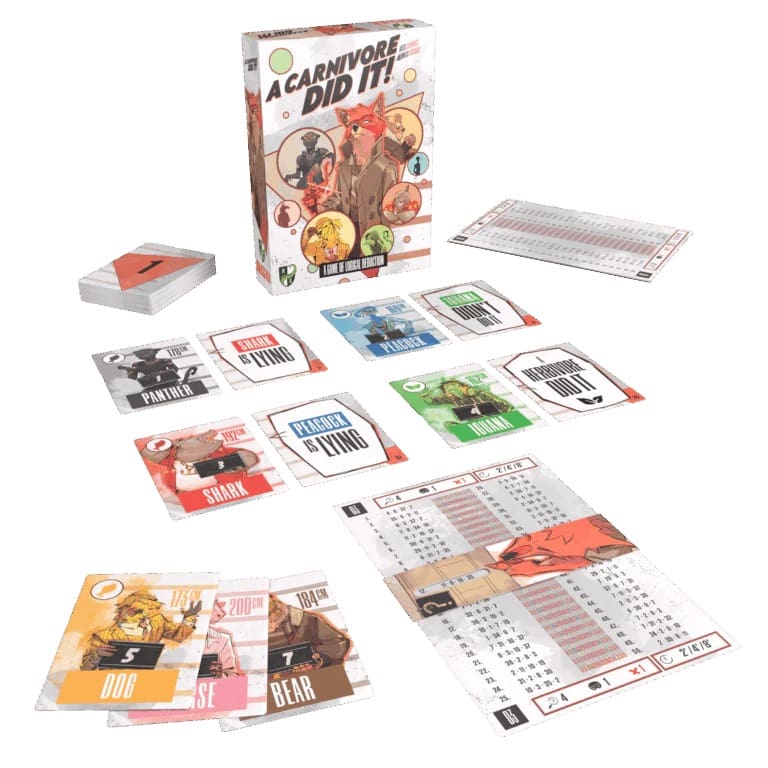
Think you can out‑smart a room full of suspects? Rack your brain and unmask the culprit in A Carnivore Did It! — a fast, cooperative logic puzzle game that rewards deduction, teamwork and careful listening.
A Carnivore Did It! — Cooperative Logic & Deduction Game
Bold facts
- Players: 1–5
- Play time: ~20 minutes
- Ages: 8+
- Core mechanics: Logic deduction, cooperative play, campaign mode, conditional reasoning
What the game is about
- Each case presents a set of suspects and short statements (e.g., “Shark is telling the truth” or “A carnivore did it”).
- You know how many culprits to find and have clues about who’s truthful or deceitful. Combine statements, eliminate impossibilities, and reveal the real perpetrator(s).
- Cases vary — sometimes there’s one guilty party, other times two or three, and later scenarios introduce conditional statements and up to seven suspects.
Why players love it
- Huge replay value: Over 2,000 unique cases, each with a single solution and steadily increasing difficulty.
- Quick, brainy play: Short rounds make it perfect for repeat plays, warm‑ups, or puzzle breaks between heavier games.
- Great solo or group puzzling: Designed for cooperative solving — work together or race the clock in campaign mode.
- Accessible for kids and adults: Simple rules but deep logical challenges that scale with experience.
Game modes & variety
- Standard cases: Rapid deduction puzzles from easy to fiendish.
- Advanced logic: Conditional statements and multi‑culprit cases add complexity.
- Campaign mode: Link multiple cases into a campaign where your score depends on how quickly you solve each case — adds pressure and progression.
How it plays (quick guide)
- Choose a Dossier (case) and set up suspects and their statements.
- Discuss clues with teammates, test hypotheses and mark contradictions.
- Reveal the solution when you’re confident — uncover lies and confirm the culprit(s).
- Repeat with new cases for a fresh puzzle every time.
Tips for better solving
- Take notes and mark contradictions immediately — a small table of truths/lies helps.
- Start by assuming the minimum number of liars/truth‑tellers and look for contradictions to rule options out.
- Work in pairs for tricky cases: one tests hypotheses while the other traces logical consequences.
- Use the campaign timer to practice speed, but don’t rush during particularly knotty statements.
Perfect for
- Puzzle lovers, families, classrooms, logic club nights, solo players who love brainteasers, and groups wanting a compact cooperative deduction game.
Find it at Mind Games — proudly Australia’s oldest and best games store since 1977.